 BabyBib
Growth
Your baby's growth chart, without the jargon.
At every visit, the pediatrician weighs and measures your baby, then puts a point on a chart. Here is what that point means, and what it does not.
A percentile is a position, not a grade
If your baby is on the 30th percentile for weight, that means that out of a hundred babies of the same age and sex, about thirty weigh less and seventy weigh more. It is a position in a group, nothing more. There is no good percentile: a child on P20 is not behind a child on P80, they are simply smaller, the way adults are smaller than one another.
What professionals look at is not one day's number but how steady the line is. A chart that climbs along its own band, whichever band that is, is a chart that is doing fine. It is a clear change of direction — not a low value in itself — that is worth raising with the pediatrician.
What the WHO charts measure
BabyBib uses the World Health Organization references, built from children followed in six countries and growing up in favorable conditions. So they describe how children grow given a good start, rather than an average of whoever happened to be measured. Four measurements are tracked:
- Weight for age
- Height (or lying length before age two) for age
- Head circumference for age
- The weight-for-height ratio
Each measurement is shown on the P3, P15, P50, P85 and P97 bands, with the current percentile written out in plain text — “Weight: 6.60 kg — P58” — so you never have to estimate it by eye.
What about the CDC charts?
In the United States, the CDC recommends the WHO standards for children under two, and its own charts from two years up. The two are not identical, and the same child can sit at a slightly different percentile on each. BabyBib shows the WHO references, the ones with international consensus.
In practice this does not change how you use it: you enter the measurements taken during the visit — the same ones written on the well-visit sheet — and you watch the line move between appointments, instead of waiting for the next one to discover a single isolated point.
Between visits
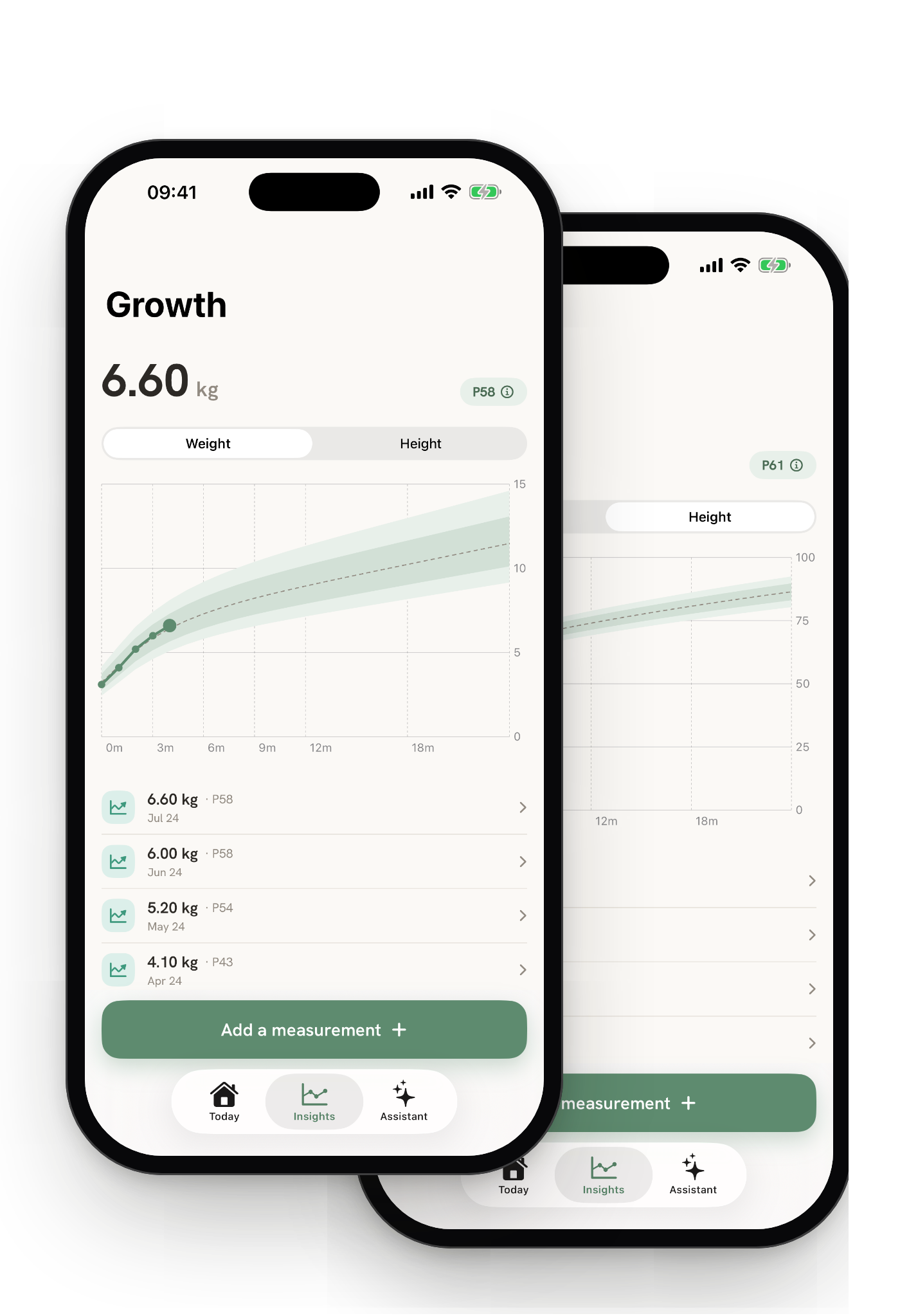
A weigh-in at home, a measurement taken on the day of a shot, a remark from the pediatrician: all of it takes seconds to log and lands on the same chart, visible to both parents. Premium adds a PDF report with the charts, volumes and sleep rhythm, ready to hand over at the appointment.
BabyBib is a tracking tool, not a medical device, and makes no diagnosis. Any question about your child's growth goes to your pediatrician or your midwife.